
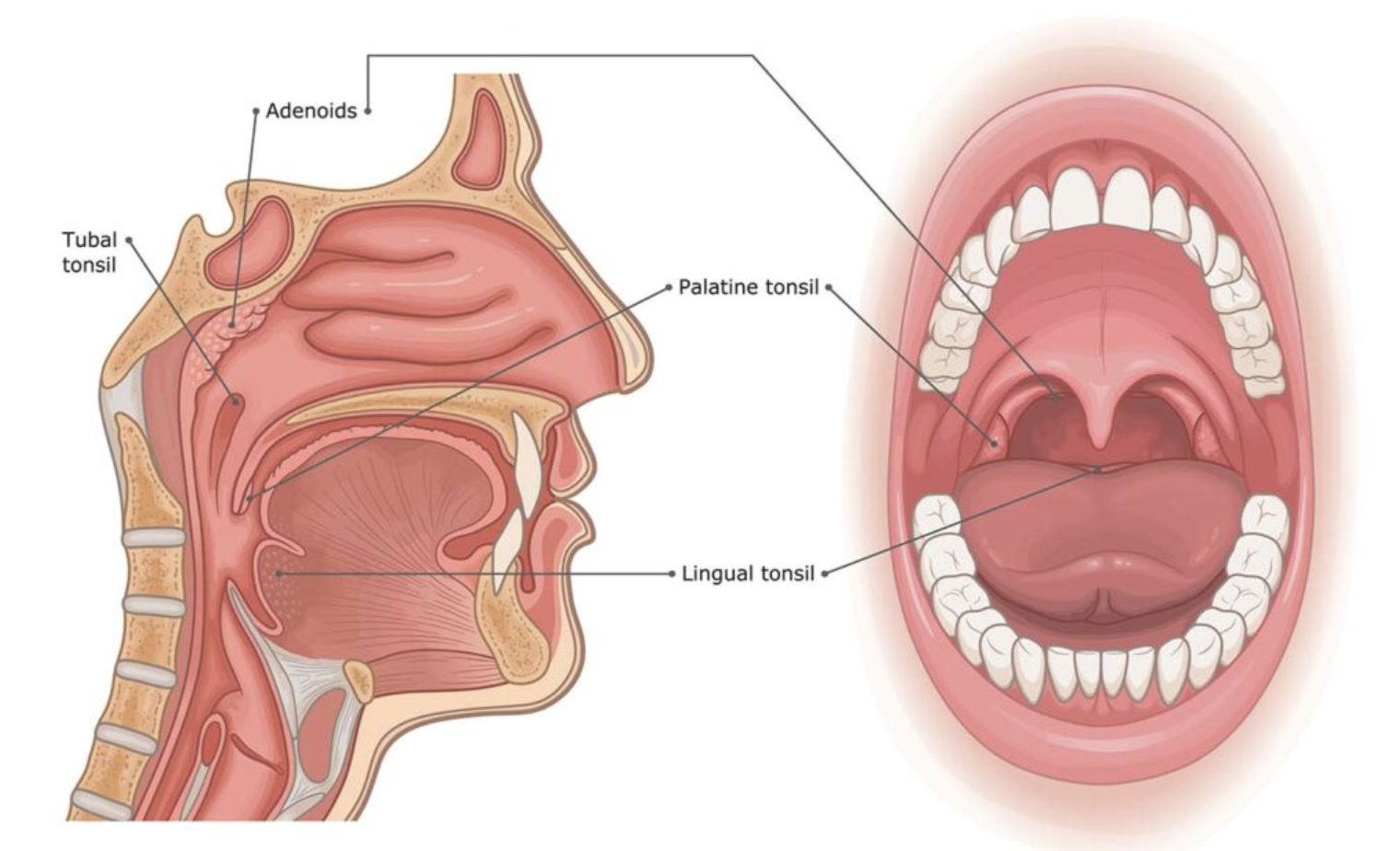
If your pediatrician or ENT has recommended taking out your child’s tonsils and adenoids, you are probably weighing whether surgery is really the only option. It is a fair question, and the honest answer is that it depends on why the airway is blocked in the first place.
Enlarged tonsils and adenoids are one cause of obstructed breathing in children. The shape and size of the jaws are another, and that second cause is easy to miss because it does not show up when someone looks in the mouth with a flashlight. At Inspire Orthodontics on the Upper West Side, Dr. Reem Abdulrahman evaluates the skeletal side of the airway: how wide the upper jaw is, how much room the tongue has, and whether the nasal passages are being squeezed by a narrow palate.
This article explains what skeletal expansion does, when it can reduce or remove the need for surgery, and when surgery is still the right call.
Why Tonsil and Adenoid Removal Gets Recommended
Adenotonsillectomy, the removal of the tonsils and adenoids, is the standard first line treatment for obstructive sleep apnea in children, and for good reason. When those tissues are enlarged, they physically crowd the back of the throat and the space behind the nose. Removing them opens that space, and many children sleep dramatically better afterward.
It is also worth knowing that surgical technique is evolving. More ENTs now shave the tonsils and adenoids (partial removal) rather than removing them fully. Ask your ENT which approach they recommend and why.
What surgery does not change is the size of the container. It addresses soft tissue inside the airway without altering the bony framework that determines how much room there was to begin with. For children whose jaws are narrow, that distinction matters a great deal.
The Piece That Often Gets Overlooked: A Narrow Upper Jaw
The roof of the mouth is also the floor of the nose. When the upper jaw is narrow, the nasal passages above it are narrow too. Air moving through a narrow nose meets more resistance, and children respond to that resistance the way anyone would: they switch to breathing through the mouth. Over time, mouth breathing changes tongue posture, and a low resting tongue removes the gentle outward pressure that helps the palate develop to its full width. The pattern reinforces itself.
Signs that skeletal structure may be part of the problem include:
- Mouth breathing during the day or while asleep, or chronically chapped lips
- Snoring, gasping, or restless sleep, including unusual sleeping positions and frequent waking
- A high, narrow palate or a crossbite
- Crowded upper teeth with visibly too little room in the arch
- Crowding of the lower front teeth, or a lack of spacing between the baby (primary) teeth
- Daytime symptoms such as fatigue, irritability, difficulty focusing, or bedwetting past the expected age
- Grinding or clenching at night
- Dark circles under the eyes and a long, narrow facial pattern
None of these confirms a diagnosis on its own. Together, they are a good reason to have the airway assessed structurally rather than only from the throat down.
What Skeletal Expansion Actually Does
Skeletal expansion widens the upper jaw itself, not just the position of the teeth. In growing children, the two halves of the upper jaw are joined by a suture running along the midline of the palate that has not yet fused. A palatal expander applies steady, gentle pressure across that suture, and the jaw widens as new bone fills in behind it.
Because the palate is the floor of the nose, widening it also widens the nasal cavity. That tends to lower nasal resistance and make nose breathing easier, which is the real objective. The straighter teeth are a genuine benefit, but in an airway focused case they are secondary. The primary goal is a larger, better shaped space for air and for the tongue.
Expansion in Children
Expansion is most straightforward while the midpalatal suture is still open. The general recommendation is an orthodontic evaluation by age seven, even when the teeth look fine. But when there are signs of a compromised airway, screening does not need to wait. We can evaluate your child, and even discuss starting treatment, as early as age 3. At that stage, orthodontic treatment is about guiding growth rather than correcting a finished result, and the window for easy, non surgical expansion is widest.
Expansion for Teens and Adults
Adults were long told that the only way to widen the upper jaw was surgery, because the palatal suture fuses with age. That is no longer the full picture. We use bone anchored expanders, which deliver force directly to the bone and allow true skeletal expansion in many patients who have finished growing. Options include:
- TAD tissue supported expander
- MARPE
- MASPE
- MSE
- DOME
- FME
The right appliance depends on your anatomy, which is why a 3D evaluation comes first. This matters for adults who had their tonsils removed as children and still snore, still wake unrefreshed, or struggle to tolerate CPAP.
So Can Expansion Replace Surgery?
Sometimes. Often the more useful question is not which one, but in what order. Cases tend to fall into three groups.
The tonsils and adenoids are clearly the main obstruction. When those tissues are very large and the jaws are well developed, surgery is likely the right answer and the fastest route to relief. Expansion is not a substitute for removing tissue that is physically filling the airway.
The tonsils are modest and the jaw is narrow. This is where expansion can change the plan. Improving nasal breathing and creating room for the tongue may resolve the symptoms without an operation, and it is reasonable to evaluate that possibility before surgery is scheduled.
Both are contributing. This is common. Children in this group frequently need both, and sequencing them thoughtfully produces a better outcome than either one alone.
That last group deserves emphasis, because it explains something many parents are not warned about: breathing problems can persist or return after tonsil and adenoid removal, particularly when the underlying jaw structure is narrow. The soft tissue was addressed and the framework was not. If your child has already had surgery and is still snoring or mouth breathing, a skeletal evaluation is worth doing.
Therapies That Work Alongside Expansion
- Myofunctional therapy: retrains tongue posture, lip seal, and breathing patterns so the results of expansion hold. Widening the palate creates the space; myofunctional therapy teaches the tongue to use it.
- Tongue tie release: when a restrictive frenum keeps the tongue tethered low in the mouth, releasing it allows proper tongue posture and supports the palate from the inside.
- Allergy and nasal care: chronic congestion from allergies or rhinitis can drive mouth breathing on its own, and is managed with your pediatrician, ENT, or allergist.
- Habit correction: thumb sucking and prolonged pacifier use both narrow the upper arch, and both are easier to address early.
What an Airway Evaluation Looks Like at Inspire Orthodontics
An evaluation with Dr. Abdulrahman is diagnostic before it is anything else. A typical visit includes:
- A sleep and breathing history covering snoring, restlessness, mouth breathing, and daytime behavior or focus
- A CBCT, a 3D x-ray, to evaluate the skeleton in all three dimensions: arch width, palate shape, and jaw relationship. The same scan lets us assess the size of the tonsils and adenoids without an endoscopy.
- An evaluation of the nasal cavity, including the septum and turbinates
- An assessment of tongue posture, lip seal, frenum attachment, and actual breathing pattern
- A clear explanation of what is contributing to the problem, and what expansion can and cannot address
- Referral to an ENT as needed, and we are happy to share the images we take. We also coordinate with your pediatrician or sleep physician, including a referral for a sleep study when one is warranted
If the finding is that the tonsils and adenoids are the primary issue, we will say so. The purpose of the evaluation is an accurate picture, not a particular treatment.
Frequently Asked Questions
Can a palate expander cure sleep apnea?
Expansion can meaningfully improve nasal breathing and reduce the severity of obstructive sleep apnea in patients whose upper jaw is narrow. It is not a guaranteed cure, and results should be confirmed with follow up evaluation and, where appropriate, a repeat sleep study.
Is my child too young for expansion?
Screening can begin around age seven. Whether to treat depends on growth and on what the evaluation finds, and in some cases the right answer is to monitor rather than start.
Is it too late if my child is already a teenager?
No. Many teens can still be expanded conventionally, and MARPE or MSE options are available once growth is complete.
Does an expander hurt?
Most patients describe pressure rather than pain, strongest in the first few days and briefly after each adjustment. Speech and eating typically settle within about a week.
Should we get a sleep study first?
If obstructive sleep apnea is suspected, a sleep study is the diagnostic standard, and we will coordinate one with your physician. An orthodontic evaluation is complementary: it identifies the structural contributors that a sleep study measures but does not explain.
My child already had a tonsillectomy and still snores. What now?
Have the skeletal airway assessed. Residual snoring after surgery often points to a narrow upper jaw or a small lower jaw, which are orthodontic findings rather than ENT findings.
Schedule an Airway Focused Consultation on the Upper West Side
If you are deciding whether your child needs tonsil and adenoid surgery, or if surgery has already happened and the breathing has not improved, an evaluation will tell you what you are actually dealing with. Call Inspire Orthodontics at (917) 830-5254, email info@inspireorthony.com, or contact us to schedule a consultation at 424 West End Ave, New York, NY 10024.
This article is for general education and is not a substitute for evaluation by a qualified medical or dental professional. Decisions about tonsil and adenoid surgery should be made together with your child's physician or ENT specialist.

.avif)